5/5review translated
“This tool is perfect! I quickly got my old CV looking new again, received a matching cover letter and practical tips for the conversation with my future boss. Really recommend it.”
Anoniem
HealthcareAugust 2026
Six kinds of work, each with a fully worked example and an explanation of why it is built that way. All names and employers are invented.
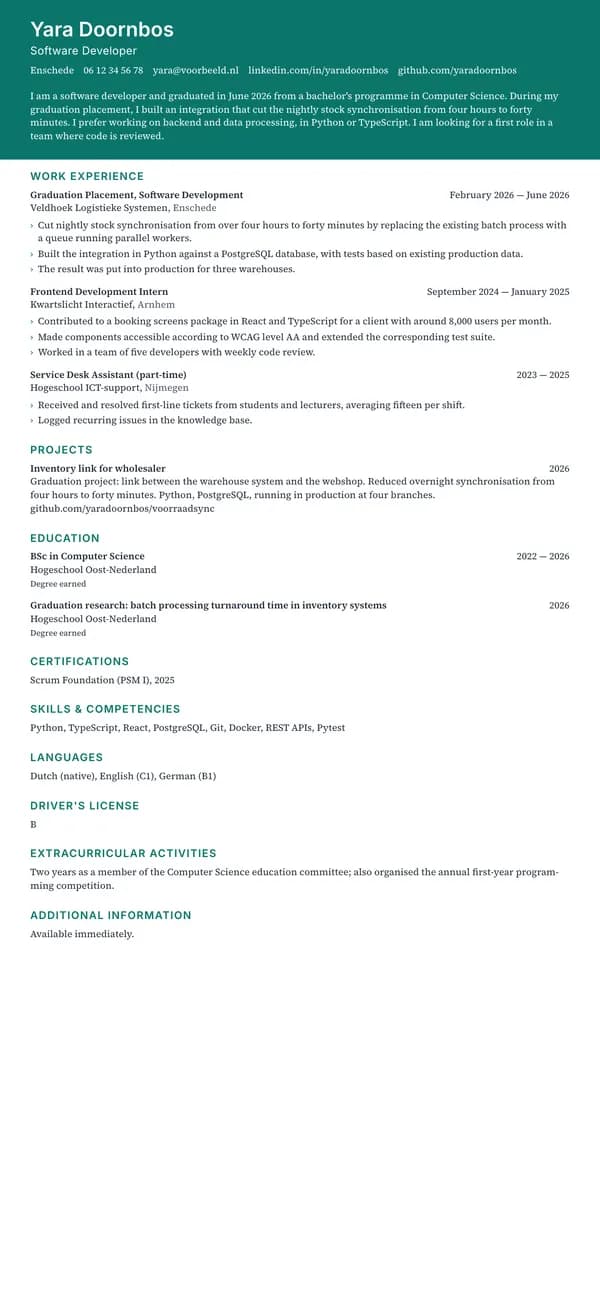
Little work experience, so the graduation research features as a full-fledged block: for a starter, that's the only substantive signal of specialisation. The stack is broken down granularly (language, framework, database, tooling separately) rather than 'backend experience', and each placement lists its scale — number of users, team size — because in IT that takes the place revenue figures hold in sales. There is no self-description such as 'eager to learn' or 'team player': what might have passed for that has been replaced by the committee she actually served on.
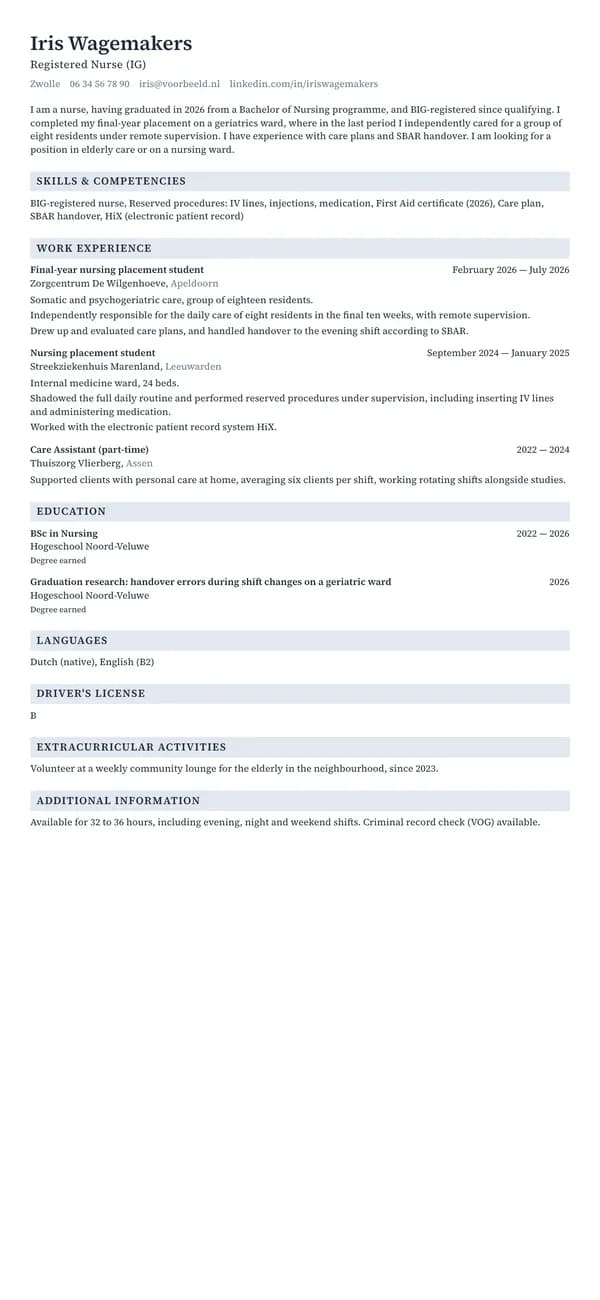
In healthcare, the job title itself says little; what counts is the context. For each placement, the setting, target group and level of independence are therefore included. Registration and certificates are listed at the top of the skills list, as they are knock-out criteria in the first round rather than a bonus. Availability is stated explicitly because rota planning in healthcare weighs into the selection process. No work experience includes a situation that can be traced back to a patient.
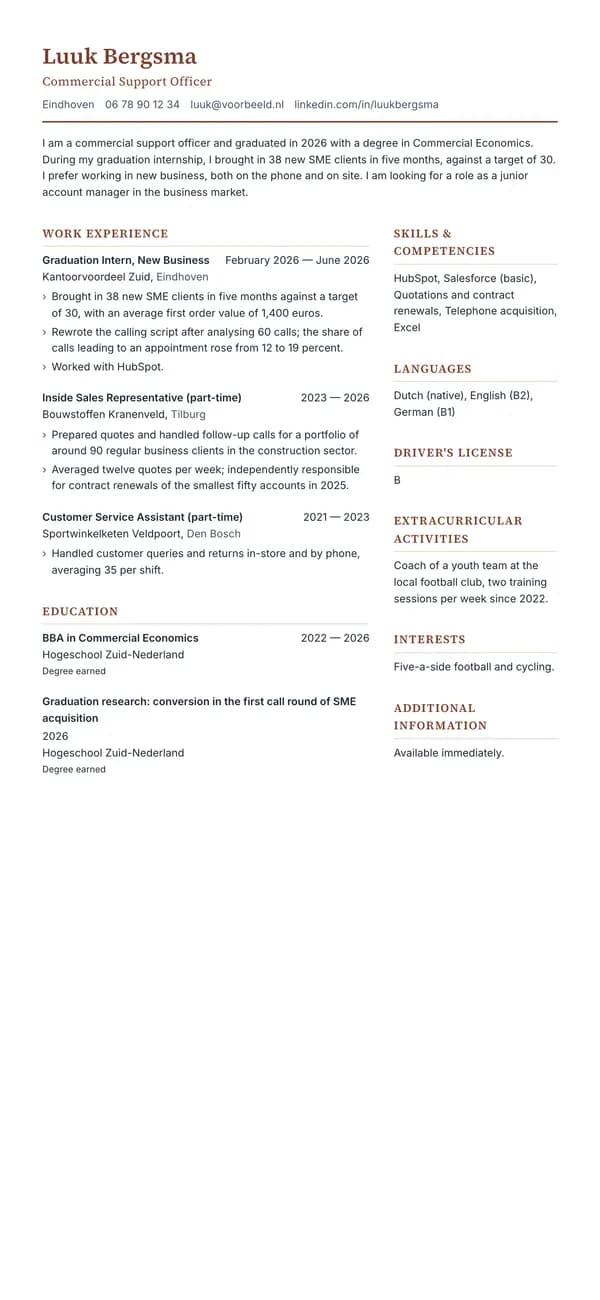
Sales is the sector that expects figures, and an entry-level candidate has them too — just smaller ones. Every result is shown with its time period, because a target without a period says nothing. The client type is explicitly stated, because the same job title can mean different work depending on the client segment. What you won't find is 'driven', 'results-oriented' or 'commercial talent': where those words would have gone, you now find what actually happened.
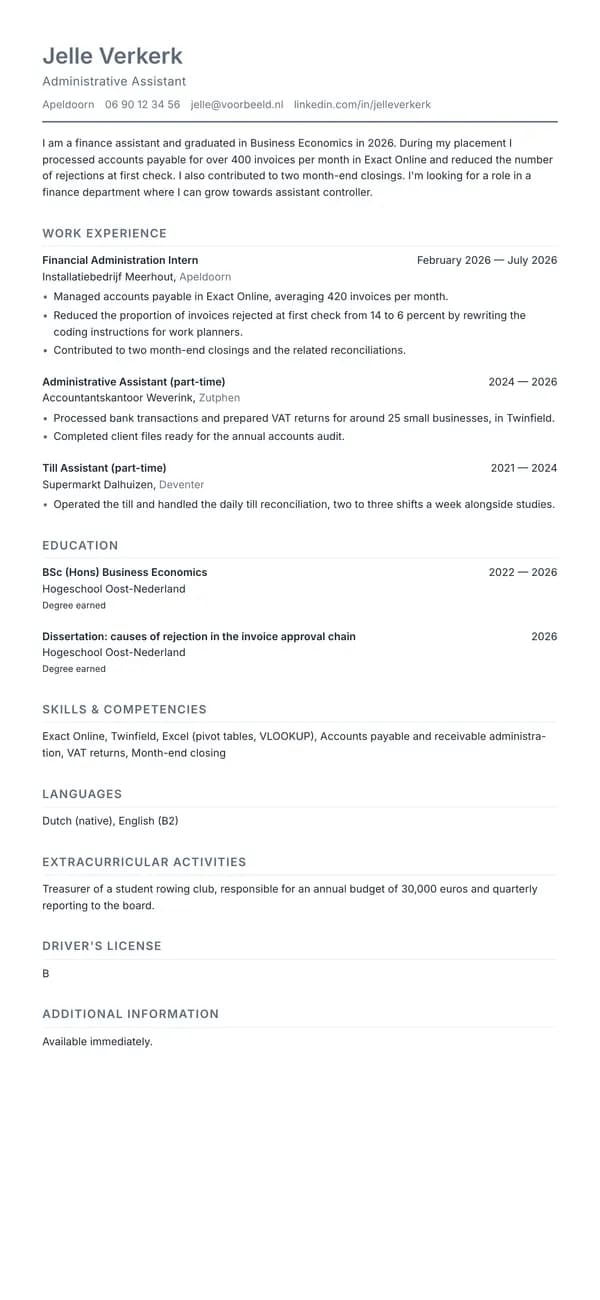
In finance, software packages aren't buzzwords but genuine search terms, so they're named and linked to the role in which they were used — not listed separately at the bottom. Quantifying works differently here than in sales: turnaround time, error rate and number of invoices processed rather than revenue. The skills list contains only verifiable items, so no 'accurate' or 'strong with numbers'.
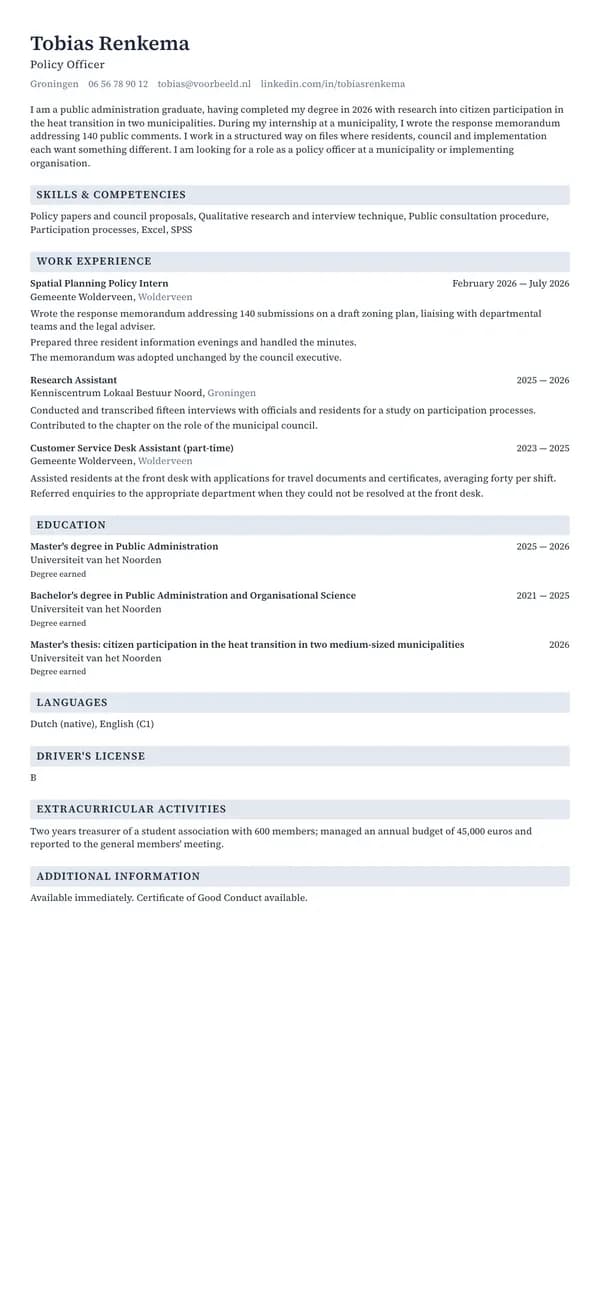
In the public sector, the CV and cover letter are explicitly checked against a predetermined list of competencies, so every experience here is written as a situation with an outcome — the STARR format, without the label above it. Board and committee work is included as full-fledged experience alongside internships, since without much paid experience, that is where collaboration and handling conflicting interests become visible. The profile summary stays within the five lines that the Dutch central government itself publishes as the standard.
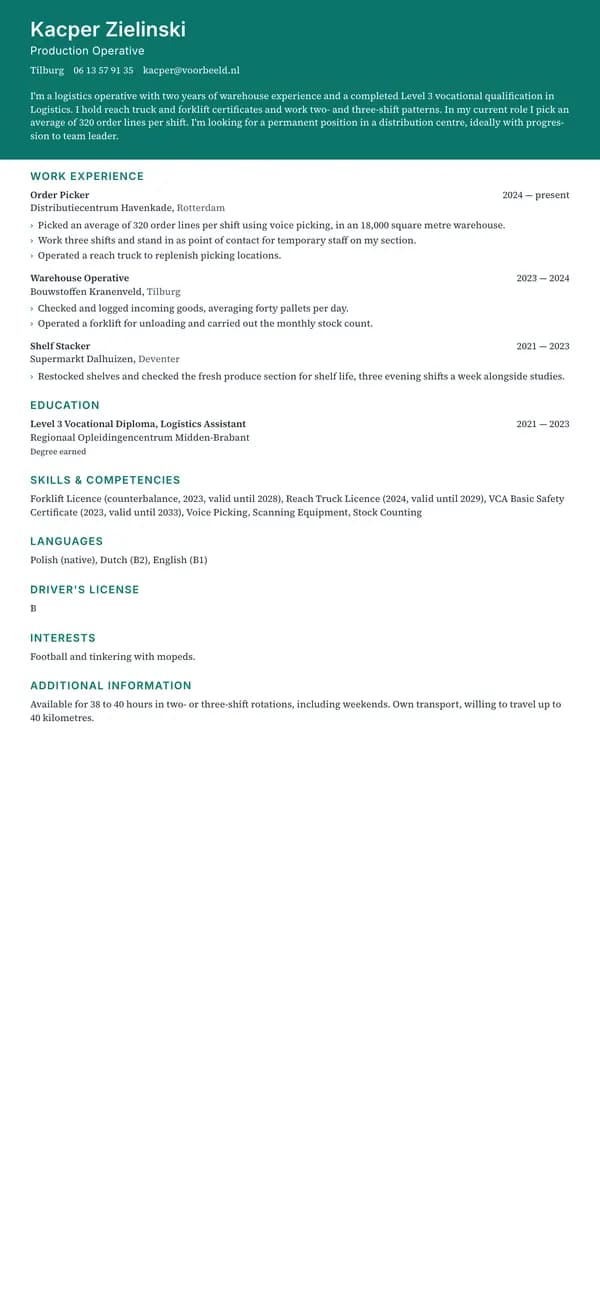
In hands-on roles, certificates matter the way medical registration does in healthcare: they're listed with type, year obtained and validity, because an employer checks them and an expired VCA is a deal-breaker. Availability is its own section rather than tucked under 'other', because shift patterns and transport often weigh more heavily here than work experience. Language level is stated per language, which is standard in logistics and production: safety instructions must be understood.
The people, employers and results in these examples are invented.
Follow us
Can we use analytics and advertising cookies, including those from our partner Google? Learn more